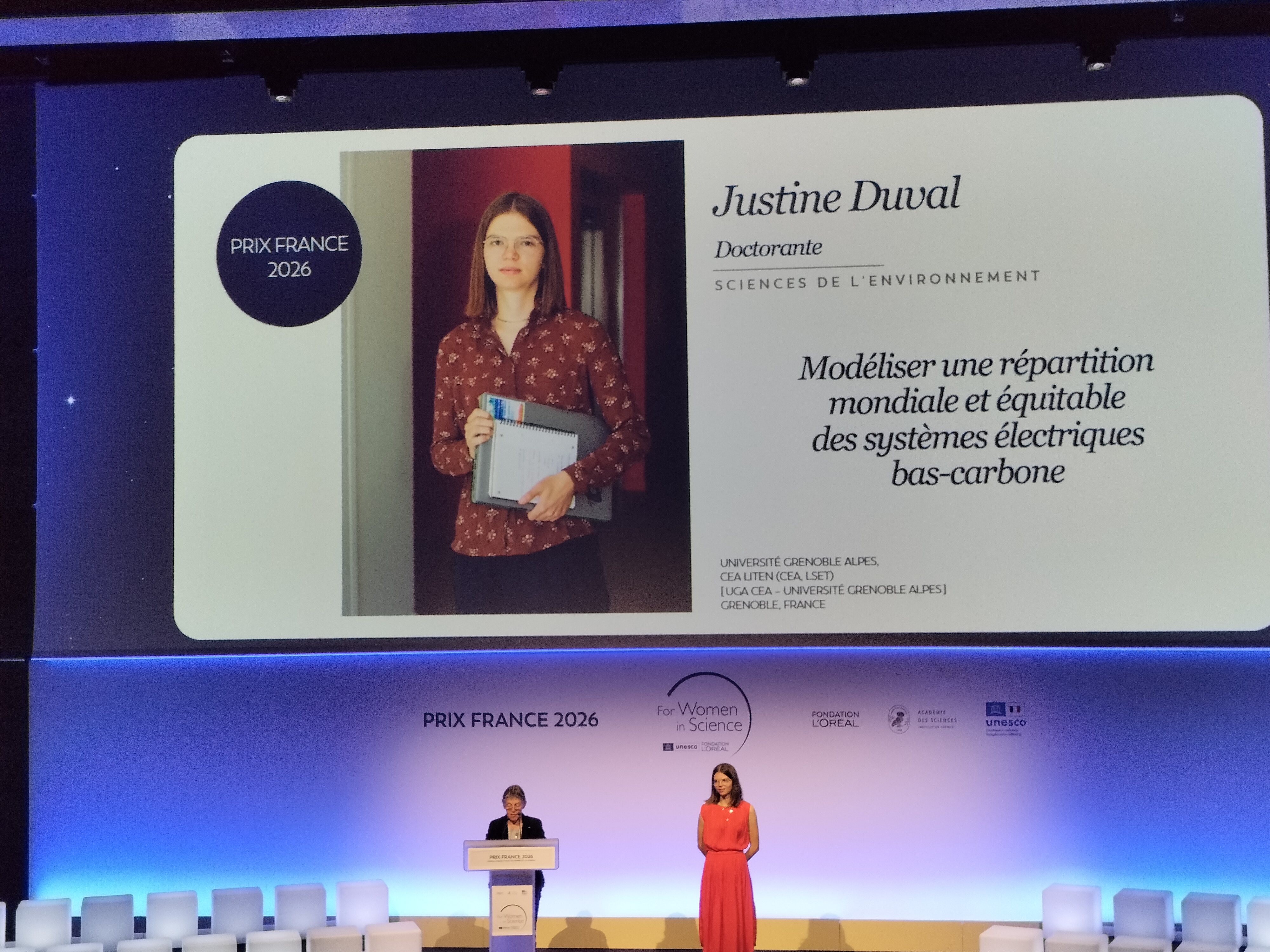
Justine Duval was awarded the 2026 L’Oréal-UNESCO For Women in Science France Prize
Congratulations to her!
A doctoral student working for EQUALS at Université Grenoble Alpes within the I-MEP² doctoral school and CEA-Liten, Justine Duval is among the 35 young women researchers honored with the 2026 L’Oréal-UNESCO “For Women in Science” France Prize.
How should low-carbon energy production and storage capacity be distributed worldwide to best meet the needs of different regions? This is the central question of the thesis of Justine Duval in the field of energetics and process engineering.
Titled Towards an equitable distribution of low-carbon energy production and storage capacity: a regionalized global approach for optimal resource allocation, her thesis examines the profound transformations the energy system must undergo in light of the need to reduce greenhouse gas emissions and electrify energy uses.
The massive rollout of intermittent renewable energy, notably wind and photovoltaic power, makes it necessary to rethink how energy systems continuously keep production and consumption in balance. The need for flexibility, meaning the ability to adjust production, storage, or consumption to variations in supply and demand, differs greatly from one region to another.
Conditions are thus not the same in northern Europe, marked by strong seasonality in heating needs and less sunshine, as in regions close to the equator, where photovoltaic production is less seasonal and can more closely coincide with cooling needs.
Justine Duval’s work therefore aims to identify, on a global scale, where the various low-carbon production and storage technologies can best be deployed, taking into account geographical specificities and the needs of each region.
It is an approach that combines energy challenges, modeling, and reflection on a more equitable distribution of resources.
“I work on a crucial issue: ensuring equitable access to decarbonized electricity for everyone. To do this, I am building a model to determine how to distribute wind turbines and solar panels worldwide in a way that is fair and respects environmental limits. Concretely, if these technologies are installed where they best meet demand while developing electricity exchanges between countries, we promote an equitable distribution of material resources on a global scale. Ultimately, these ‘energy justice’ scenarios could feed into international cooperation, and even the work of the IPCC (Intergovernmental Panel on Climate Change).”

Enjoy Reading This Article?
Here are some more articles you might like to read next: