
EQUALS is a research project funded by the French National Research Agency (ANR) as part of the 2025 Generic Call for Proposals (ANR JCJC). The project started in early 2026 and will run for four years.
The project acronym EQUALS stands for "EQUItable Allocation of Low-carbon Electricity Sources in a Changing and Resource-limited World."
👉 Official ANR project page

Project Summary
EQUALS addresses a major global challenge: transitioning from fossil fuel-based energy systems to low-carbon alternatives, such as intermittent renewable energy sources (IRES), nuclear, and hydropower. In a world with limited raw material availability and planetary boundaries, this transition must ensure optimal resource use to provide the best possible energy service. Indeed, the relevance of deploying an energy source varies from region to region, depending on climate, energy uses, and territorial specificities.
Funded by the ANR JCJC programme and coordinated by Arthur Clerjon, EQUALS explores how solar and wind energy can be most effectively distributed worldwide to reduce reliance on fossil fuels while respecting planetary boundaries, resource limitations, and territorial specificities.
To analyze such differences, we develop an innovative electricity system optimization model that integrates raw material availability at its core. This global analysis will be regionalized, taking into account local climates, energy demand, and territorial characteristics. The model will focus on the temporal match between electricity demand and IRES supply (e.g., wind, photovoltaic), accurately assessing flexibility needs and power system sizing. The goal is to depict a global distribution of low-carbon energy sources that minimizes fossil fuel use, considering environmental and territorial constraints.
This project is built on a transparent methodology and an open-source model, making the results accessible to a wide audience. With this interdisciplinary and open approach, the project aims to co-construct transition scenarios, fostering broader participation in decision-making processes for energy systems sustainability.
Overall, EQUALS seeks to:
- Identify where and how low-carbon electricity can meet local demand;
- Integrate constraints from planetary boundaries, material availability, and environmental compatibility;
- Design deployment strategies that respect both regional equity and global sustainability.
Preliminary Results
EQUALS builds on previous research and incorporates the ongoing PhD work of Justine Duval. Below is an illustration of the project’s approach, from the 2025 ECOS International Conference:
👉 Duval et al. (2025) – ECOS Conference Paper
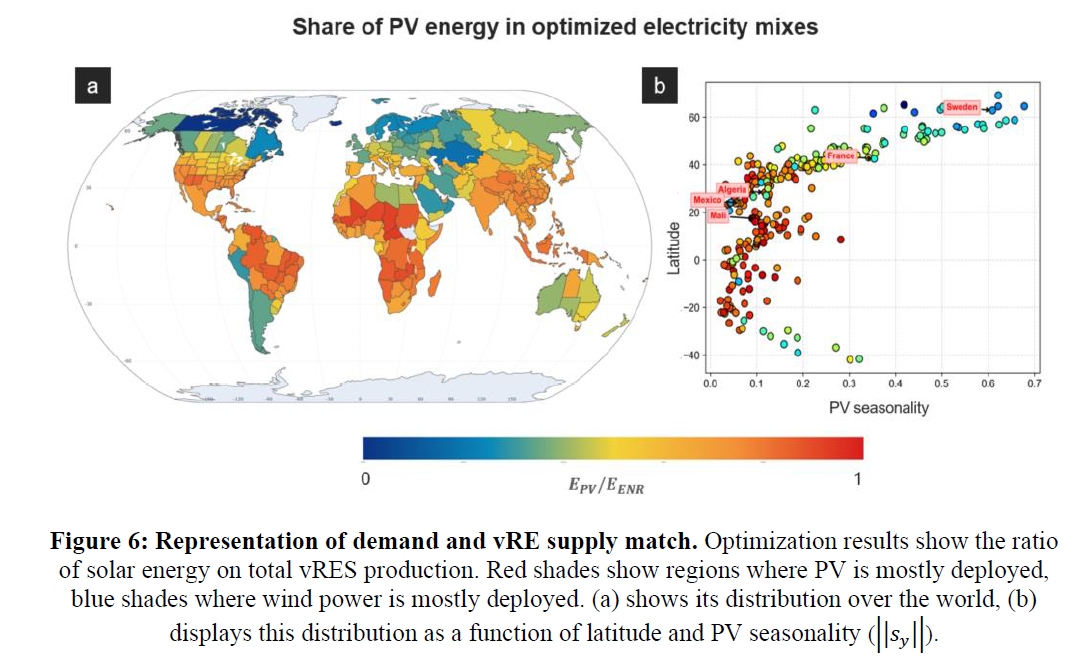
Figure: Optimal mix of PV and wind by region (a), and by latitude (b), minimizing the need for dispatchable power. Source: ECOS 2025.
Downloads & Links
📄 Full Proposal (PDF) 📃 Pre-Proposal 📝 Project Summary 🔗 ANR Project Page
Coming Soon
- 📊 Interactive platform for exploring deployment scenarios
- 📁 Access to datasets and source code
- 📚 New publications and methodological notes
Project supported by the ANR — ANR-25-CE03-5866.
Last updated: June 2026